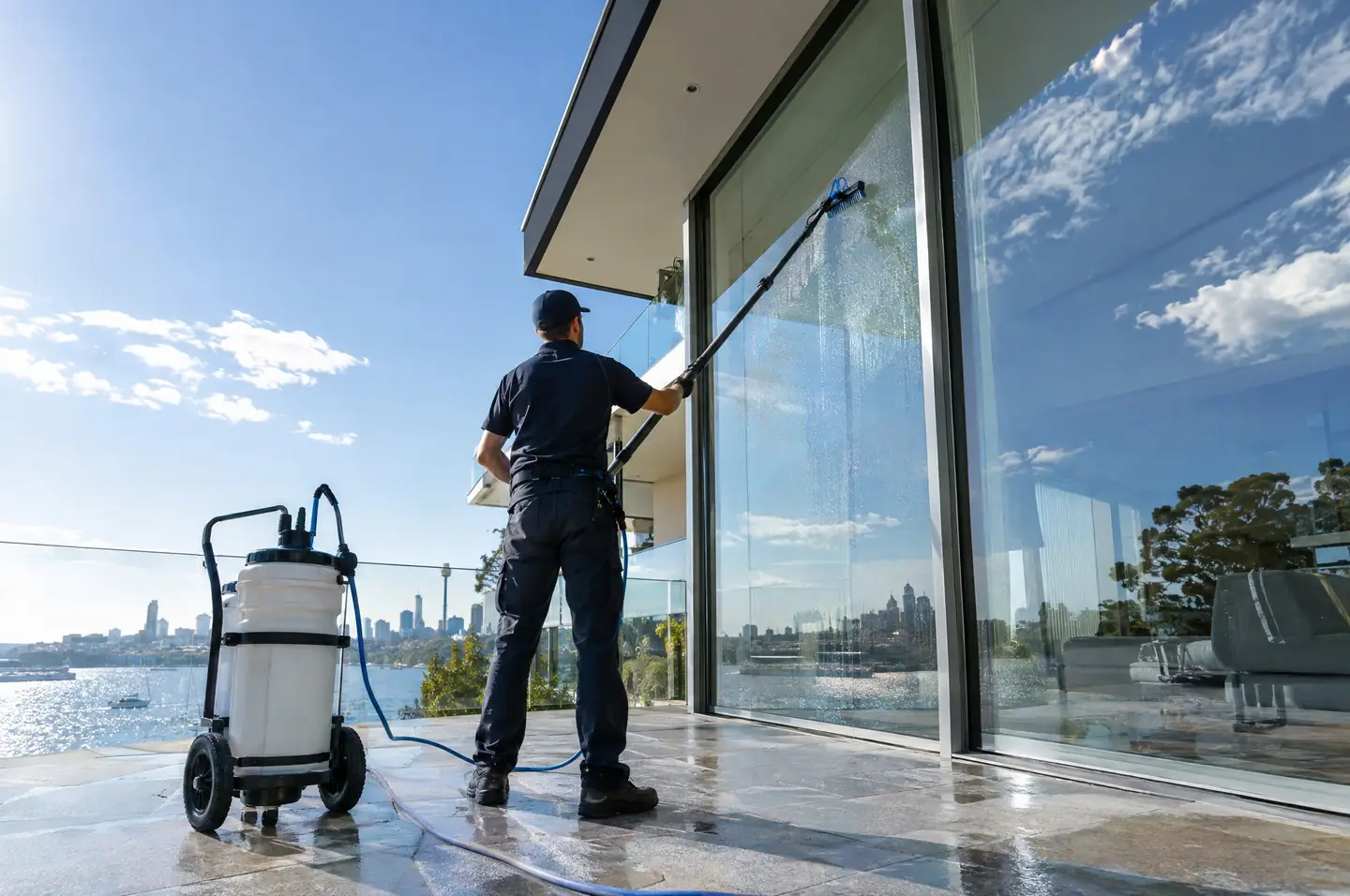
About residential window cleaning
Residential window cleaning covers the glass, inside and out, plus the parts people forget: frames, sills, tracks, flyscreens, louvres, skylights and glass doors. Outside, most tradies now use a water-fed pole with purified water that dries spot-free, keeping their feet on the ground up to the third or fourth storey. Inside, it is still the squeegee, a scrim and care around furniture and floors. It is worth booking after a house wash or building work, before a sale or a party, when the salt haze finally wins against the view, and on a regular cycle in coastal homes where the film returns within weeks.
Glass works hard in these suburbs. Harbour and ocean-facing homes in Vaucluse, Dover Heights, Clontarf and Whale Beach are built around the view, with big fixed panes and sliding doors that carry a salt film after every onshore wind. Sprinklers and bore water leave mineral spots that etch if they are left. Leafy North Shore blocks in Lindfield and Gordon trade salt for pollen, sap and spider webs. Federation homes keep timber sashes, leadlight and small panes that need a hand finish, while Paddington terraces have narrow light wells and glass only reachable from inside. In apartments, the outside of the glass is usually common property, so the strata manager books that side.
Nobody licenses window cleaners in NSW, and home jobs sit well below the threshold where any contractor licence applies. That makes vetting the whole protection. Every window tradie here has let us match their photo ID to an active ABN, has proved their public liability cover is current, and has shown us recent work in these suburbs along with references. They agree to written quotes and to the Australian Consumer Law, which requires services to be done with due care and skill. Where ladders or roofs are involved, the usual work health and safety rules on falls apply to them as they do to any tradie.
What the job usually includes
How it works
- Tell us about the windowsSay roughly how many windows and doors, how many storeys, and whether you want inside, outside or both. Mention big fixed panes, skylights, leadlight, louvres, tinted film, flyscreens and anything hard to reach. A couple of photos of the house from outside are more useful than a count.
- We match vetted local window cleanersThe job goes to vetted, independent window tradies who already work in your suburb and carry pure water systems and the right poles for your height. We have matched their ID to an active ABN, seen their public liability certificate and looked at recent local work. Matching is free and nothing obliges you to book.
- They quote you directly, in writingEach tradie quotes under their own business name, usually from your description and photos, sometimes after a visit for a large home. The quote should list what is included, whether screens, tracks and frames are in, how upper glass will be reached, and what a regular cycle would look like if you want one.
- The cleanA careful tradie starts outside with purified water, working top down and scrubbing frames before glass, then moves inside with drop sheets and a bucket that never touches your floor. Tracks are vacuumed, screens washed, sills wiped. Tinted and leadlight glass gets soft tools only. Ladders are footed and secured, and nobody leans out of an upper window to reach the next pane.
- After the jobCheck the glass with the sun behind it and look at tracks and sills, not just the panes. Spots that were there before may be mineral etching, which the tradie should have pointed out. If you want a regular cycle, agree the interval now. Tell us how they went; your feedback is what keeps the network good.
Spot-free glass without marks on anything else
Technique is visible from across the room. Good cleaners scrub the frame and the glass edges before the pane, so dirt is not dragged back across it, and they finish with a dry scrim along the edges where drips form. Outside, purified water matters: ordinary tap water leaves mineral residue as it dries, and a water-fed pole with proper filtration rinses the glass clean and lets it dry naturally without spots. They know the limits of the tools too. Blades and scrapers are kept off tinted film, off toughened glass that can scratch, and off the soft glazing putty of old timber sashes. Leadlight and louvres are hand work.
Care for the rest of the house is the other half. Drop sheets go down inside, furniture is moved and put back, and the tradie's bucket and boots never meet your timber floors. Outside, garden beds under the windows are not trampled and painted sills are not flooded. On two-storey homes they reach high glass with a pole rather than a ladder on soft ground or a lean from a window. Salt, sprinkler spots and cement splash from recent building work are explained before the job, not discovered after, because some etching does not come out and a professional would rather say so.
Questions worth asking the tradie
Frequently asked questions
Outside glass gets dirty far faster, especially near the coast, so many homes book the outside more often and the inside a few times a year. Kitchens, bathrooms and rooms with pets or small children get an inside film sooner. Agree a pattern with the tradie rather than defaulting to both every visit.
Usually the spots were already etched into the glass by sprinklers, bore water or salt that sat too long. Cleaning removes the loose mineral but not the etching. Some can be improved with a mild acid treatment or polishing by a specialist, and some cannot. A good tradie will show you the difference before starting.
Yes, but with soft tools only. Window film sits on the inside face and is easily scratched by blades, abrasive pads or ammonia-based cleaners. Tell the tradie which panes are filmed, and ask them to use a soft applicator and squeegee with a mild solution on those.
Homes facing the ocean or an open stretch of harbour often have the outside done every month or two, because salt haze returns quickly and holds dust. Sheltered homes stretch much longer. The honest answer is as often as the view bothers you, and a regular cycle keeps each visit quicker.
For most strata schemes, the outer face of the windows counts as common property, so the owners corporation arranges external cleaning, often with rope access or a lift for the whole building. You can book the inside yourself. Check with your strata manager before engaging anyone to work on the outside of the building.
No. There is no licence for window cleaning in NSW, which is why ID, ABN, insurance, references and examples of recent work are the checks that matter. Ask to see the insurance certificate, especially where ladders or upper floors are involved.