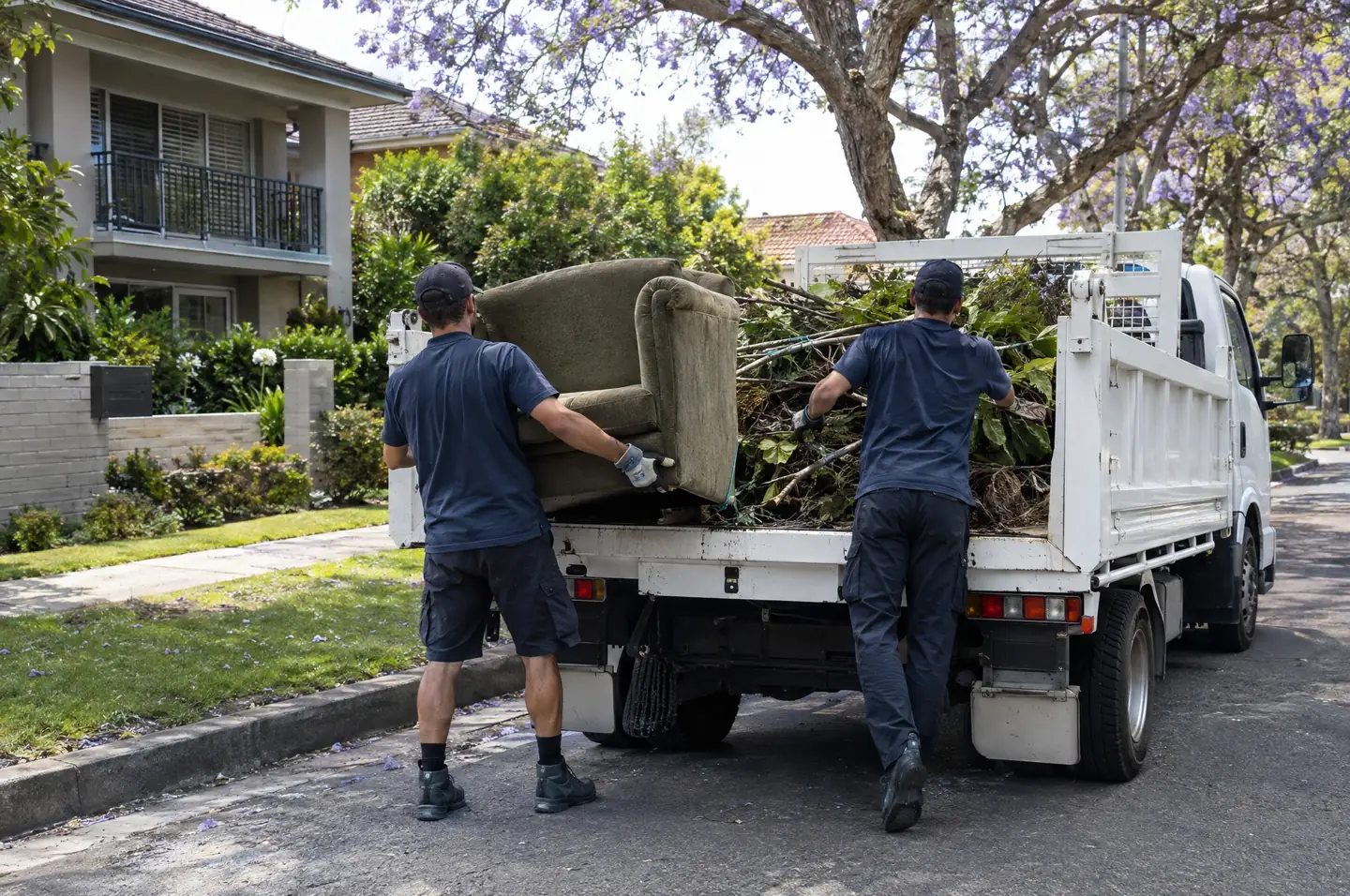
About green waste removal
Green waste removal is the collection and lawful disposal of bulk garden material: branches after a storm, the pile from a hedge cut, palm fronds, bamboo, vines, turf, soil and stumps. It is usually a separate job from general rubbish because garden material is processed into mulch and compost, and a load contaminated with plastic, treated timber or rubbish is rejected or landfilled. It is worth booking when the volume is beyond what the organics bin and a council vegetation collection can take, when material is too long or thick for the kerb, or when a clean-up has left a heap that needs to go now.
The suburbs generate different piles. The Northern Beaches peninsula drops cabbage tree palm fronds, spotted gum bark and Norfolk pine needles year round, and east coast lows bring down limbs from Avalon to Manly. The Upper North Shore's blue gums and turpentines shed branches and heavy litter in Wahroonga, Turramurra and St Ives, where properties back onto bushland. In the Eastern Suburbs the issue is more often overgrown murraya, bamboo and climbers in Paddington and Woollahra courtyards with no side access, and large trimmed hedges in Bellevue Hill. Councils collect garden organics at the kerb, but booked vegetation collections have strict limits on length, thickness and bundling.
No licence applies to moving green waste, so the checks on the tradie are what protect you: identity and ABN verified, public liability insurance current, local references and photos, and an agreement to written quotes and tidy sites. The environmental rules are firm. Garden waste must go to a licensed organics facility or an approved council collection, and tipping it over a back fence into a reserve is illegal dumping that spreads weeds through bushland. Priority weeds under the Biosecurity Act, such as lantana, need to be bagged and landfilled rather than chipped. Trees above council size limits still need a permit before they come down.
What the job usually includes
How it works
- Tell us about the pileDescribe what is in it, roughly how big it is in trailer loads, and whether it is loose, bundled or still on the plant. Say where it sits, how far the truck can get from it, and whether there is soil, turf, stumps or treated timber mixed in, because those travel separately.
- We match local green waste tradiesYour job goes to vetted, independent garden and waste tradies who work in your suburb and have passed identity, ABN, insurance, work-history and conduct checks.
- Written quotes, direct to youInterested tradies contact you and quote in writing under their own business name, based on your photos or a visit. The quote should say what volume it covers, whether chipping on site is an option, how contaminated or weedy material is handled and where the load goes. You choose, with no obligation.
- The removalA careful crew keeps green material separate from soil and rubbish, bags seeding weeds and priority weeds, cuts long limbs down for transport, and covers the load. Chipping on site leaves you mulch and saves a trip; otherwise the material goes to a licensed organics facility. Lawns are protected from wheelbarrow ruts and the kerb is left clear.
- AfterwardsCheck the lawn, beds and the street for debris, ask where the load went if you want the receipt, and let us know how the tradie performed. Feedback after each match is part of how the network stays honest.
Clean loads, lawful destinations
Green waste is only valuable if it is clean. A good crew keeps branches and clippings separate from soil, turf, plastic pots, wire and treated timber, because a single fence paling or a bag of rubbish can see a whole load turned away from the organics facility and sent to landfill. They cut material to lengths that pack tightly, cover the load so leaves do not blow off on Pittwater Road, and ask before chipping, since chipping lantana, bamboo or anything carrying seed just spreads it. Where you want mulch, they chip on site and leave a tidy pile where you ask.
The destination is where cheap operators save money. Green waste belongs at a licensed organics facility or in a council collection, not in a reserve, a vacant block or a creek line, where garden escapees such as asparagus fern, morning glory and madeira vine take hold. Ask which facility they use and for the receipt. Good tradies also keep the lawn and paths intact, protect sandstone edges from barrows, blow the street clean and tell you honestly when a stump needs a grinder rather than a mattock, or when a branch they have been asked to cut belongs to a tree that needs a council permit.
Questions worth asking the tradie
Frequently asked questions
For small, steady volumes, yes. Councils here collect garden organics at the kerb, several combined with food scraps, and most run booked vegetation collections with limits: Ku-ring-gai accepts pieces no more than 1.2 metres long and 15 centimetres thick, Willoughby wants bundles under a metre with branches under 75 millimetres, and Waverley asks for one-metre bundles. A day's hedge cut, a storm limb or a stump is beyond those limits, which is when a tradie makes sense.
Stumps are either ground out with a stump grinder or dug and cut, and both produce heavy material that goes as a separate load. Logs may be cut for firewood if you want them, or chipped if small enough. Councils generally will not take stumps or logs at the kerb. If the stump belonged to a protected tree, keep the permit paperwork.
Not in the same load. Soil, sand and turf are heavy and are processed differently, and most organics facilities reject green waste with more than a little soil in it. A tradie will quote soil and turf separately, usually by weight, and may take clean soil to a facility that accepts fill.
Material carrying seed, and priority weeds such as lantana, privet, asparagus fern and madeira vine, should be bagged and sent to landfill rather than chipped or composted, so they do not spread through mulch. A tradie who treats everything the same is spreading the problem. Councils publish lists of priority weeds for the Greater Sydney region.
Often. Chipped prunings make useful mulch for beds, it saves transport and tipping, and the machine can be fed straight from the pile. It is noisy, so it falls under the NSW noise rules for power tools, and it is not suitable for weedy, seeding or diseased material, or for palm fronds, which shred into stringy fibre. Ask the tradie what they recommend.
Yes, they are a constant on the Northern Beaches and along the harbour. Fronds are bulky and awkward rather than heavy, and pine needles are usually raked and bagged. Both go to an organics facility. Regular garden maintenance keeps them from piling up in gutters and on pool covers.