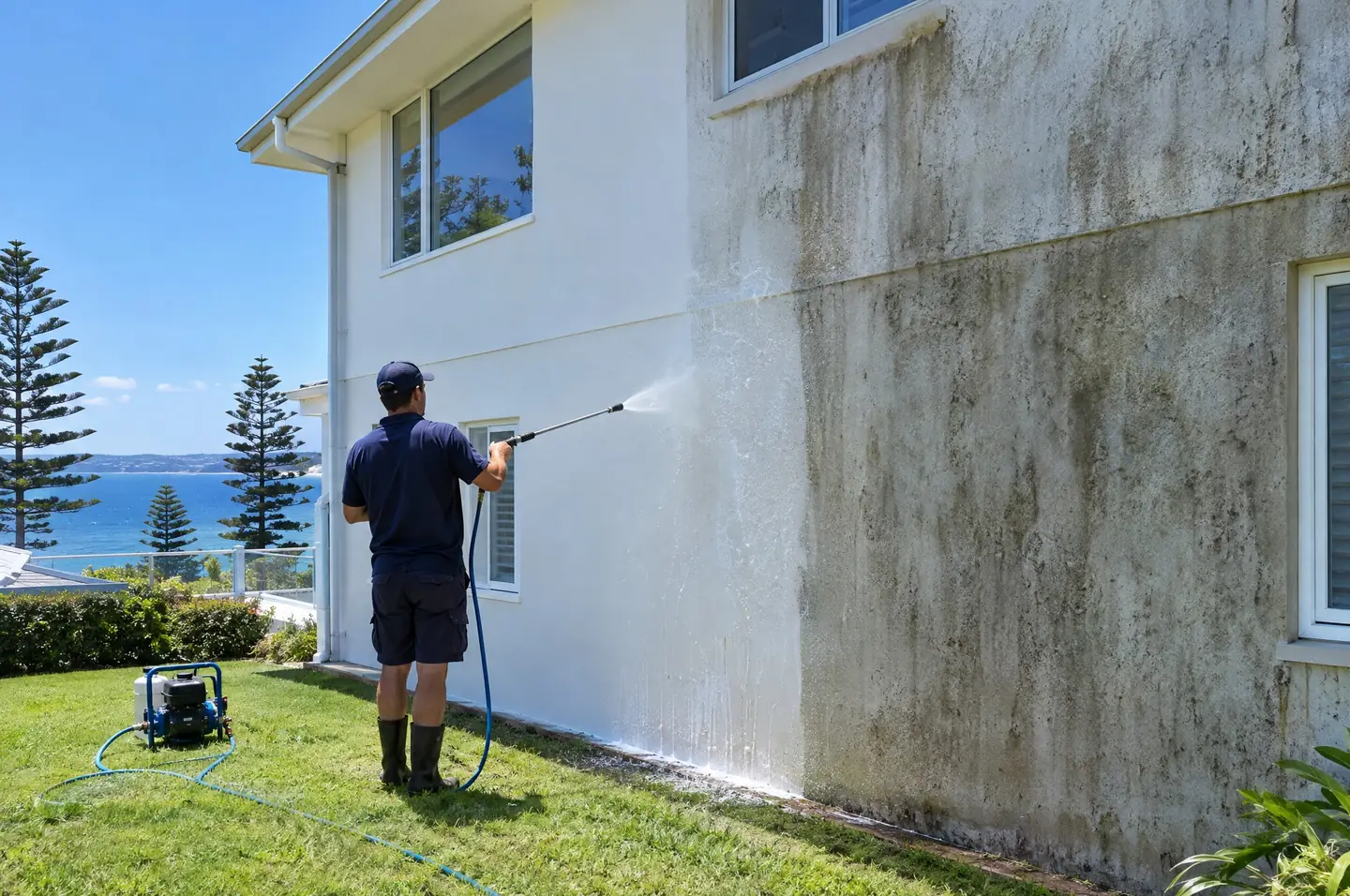
House washing in Fairlight
A typical Fairlight job is a split-level house or a semi whose front faces North Harbour and whose back is cut into the hill. The harbour side carries a salt film on render and paint and lichen on tiled roofs; the uphill side, the retaining walls and the sandstone stairs between levels sit in shade and grow black mould and green slime. Red-brick flats on Lauderdale Avenue and around Sydney Road have painted balconies, fibre cement soffits and stairwells that streak. Gutters fill with leaves from the foreshore bush and the golf course trees, and overflowing gutters stain the walls below. Owners usually ask for walls, gutters, paths and retaining walls in a single visit.
The vetted tradie soft washes render, painted brick, fibre cement and sandstone, applying a cleaner, letting it work and rinsing gently, and saves high pressure for concrete and paving. Fibre cement on anything built before 1990 gets no pressure at all, because it may be asbestos cement; the tradie flags it instead. Because the block falls toward the harbour, run-off is managed from the top level down, with the lower edge bunded and water sent to lawn, garden beds or a vacuum rather than the drain that leads to the water. Houses that sit below the road put gutters and gables at height, so poles from the lower garden, anchors or a platform come into the plan.
Post the levels, the surfaces, the number of steps from the street, where a van can legally stop and the nearest tap, with photos of the worst walls and the retaining walls. It goes to vetted exterior cleaners covering Fairlight, Manly and Balgowlah, and the tradie who takes it rings you and quotes directly. Look for a written quote covering the surfaces, the method, how run-off will be handled on the slope and what access equipment is coming. Homeowners pay nothing for the introduction and can decline. On this hillside a dry spell matters, because shaded walls and stairs take longer to dry before any treatment or sealing.
Exterior cleaning services you can post
Frequently asked questions
Yes, with a biocide and low pressure rather than a blast that would open the stone's face. The tradie works from the top step down and catches the run-off at the bottom landing. Stairs treated this way stay cleaner for longer, and a breathable sealer afterwards slows the regrowth.
If it predates 1990, it is treated as asbestos cement. Gentle low-pressure rinsing without abrasion is the most a tradie will do, and some will leave it alone. Pressure washing, sanding or scraping it is out. If more than ten square metres ever has to go, that is a licensed asbestos removalist's job.
From the garden side with water-fed poles and gutter vacuum poles, from a ladder with a stabiliser where the ground allows, or with anchors and a harness on steep drops. Fall controls are compulsory under the WHS Regulation wherever a fall could hurt someone, so ask how the high side will be done.
Onto your lawn or garden beds, or into a recovery vacuum, never over the edge to the neighbour or the street. Pollutants entering stormwater is an offence in NSW, and in Fairlight the drains reach North Harbour quickly. The tradie bunds the low side of each level before starting.