Sydney's tap water meets the Australian Drinking Water Guidelines, so a filter is a choice about taste, chlorine, sediment or an old pipe run, not about safety. The cost splits three ways: the unit, the plumber's time to connect it, and the cartridges you buy for years afterwards. This guide sets out the published ranges for each part and what a quote should cover.
The short answer
According to The Quote Yard's NSW water filter installation page (Sydney metro rates, undated), fitting an under-sink filter you have already bought costs $150 to $300, an under-sink system supplied and installed costs $350 to $800, a whole-house filter $800 to $2,500, and a reverse osmosis system $600 to $1,500, with a cartridge replacement visit at $80 to $150 plus the filter. On the equipment side, Choice's water filter buying guide (March 2024) puts under-sink units at $180 to $600 to buy and $200 to $800 a year in cartridges, and counter-top units at $60 to $350. Puretec's own price list (prices including GST) shows under-sink kits from $280 for the most basic unit to $1,184 for a reverse osmosis tap and filter kit, whole-house housings from $445 for a single-housing unit to $1,183 for a twin, and wall-mounted multi-stage systems from $3,145 to $5,899.
For the plumber's time, What's The Damage's Sydney plumber guide (November 2026) lists $92 to $230 an hour, typically $140, with $130 to $170 on the North Shore and Northern Beaches and a call-out fee of $69 to $170.
TPS Trade Connect does not set prices; the tradies you're matched with quote directly, and quotes vary with access, condition and size. Take the figures as a way to separate the cost of the unit from the cost of the work.
What drives the price
The type of system
An under-sink filter treats one tap, usually a separate small faucet beside the mixer. A single cartridge handles taste and chlorine; a twin adds a sediment stage; reverse osmosis adds a membrane, a tank and a drain connection. A whole-house filter sits on the incoming main, treats every tap and shower, and needs housings sized for your flow. Each step up adds parts and plumbing time.
The tap and the benchtop
Most under-sink kits include a dedicated tap. If your sink has a spare hole, fitting it is quick. A hole through a stone or porcelain benchtop is usually drilled by a stonemason or a plumber with a core bit, and is often quoted separately.
Where the water comes in
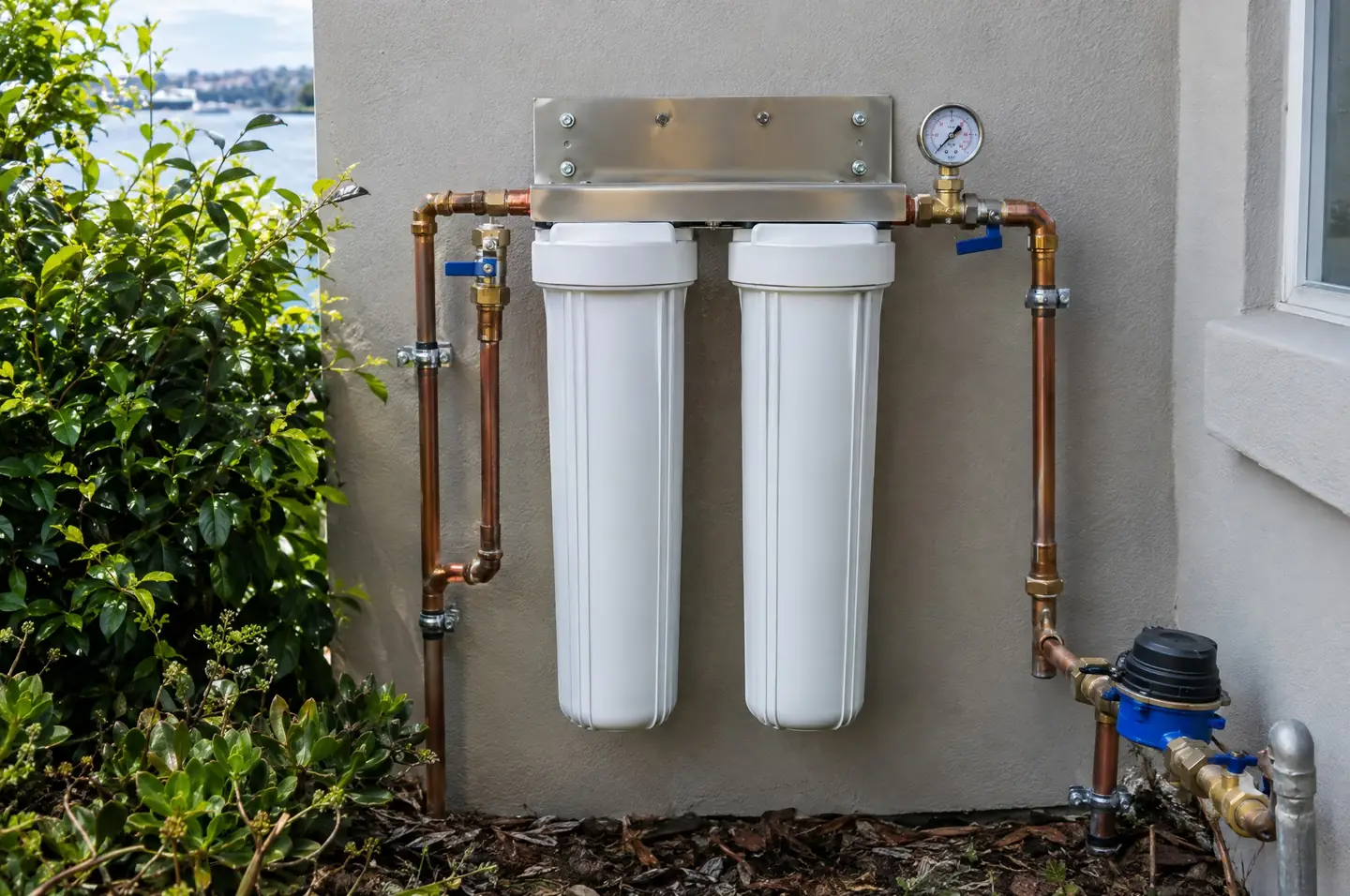
Whole-house units go on the main after the meter and the pressure-limiting valve. On a flat Lindfield block the pipe is easy to find. On steep harbour and beach blocks in Castlecrag, Clontarf or Newport the main may run under a driveway or through sandstone, and the housings need a sheltered spot, a bracket and bypass valves so cartridges can be changed without turning the house off.
Age of the pipework
Pre-war houses in Paddington, Randwick and Mosman may still have galvanised steel pipe inside, which sheds rust and sediment, and older brass fittings. A sediment stage ahead of the carbon cartridge extends its life, and a plumber may suggest replacing a corroded stop tap while the water is off, which is a separate item. Acreage blocks around Terrey Hills and Duffys Forest that use tank water need a different brief again.
Strata and access
In an apartment, a whole-house system is normally impossible because the supply is a shared riser; under-sink is the realistic option, and anything that alters common property needs owners corporation approval. Tight cupboards, a dishwasher on the only cold tee and no power nearby for an ultraviolet unit all add time.
Published price ranges for Sydney
Everything in the table is a published estimate or a published price list from the source named. None of it is a TPS Trade Connect price; the plumber you are matched with quotes your own kitchen or meter position.
| Published by | Item | Figure |
|---|---|---|
| The Quote Yard, NSW page, Sydney metro rates (undated) | Under-sink filter, install only; supply and install | $150 to $300; $350 to $800 |
| as above | Whole-house filter, installed | $800 to $2,500 |
| as above | Reverse osmosis system; fridge water line | $600 to $1,500; $200 to $400 |
| as above | Cartridge replacement visit | $80 to $150 plus the filter |
| Choice, buying guide (March 2024) | Under-sink unit to buy; cartridges per year | $180 to $600; $200 to $800 |
| as above | Counter-top unit to buy; cartridges per year | $60 to $350; $100 to $200 |
| as above | Jug filter to buy; cartridges per year | $20 to $75; $84 to $432 |
| Puretec, manufacturer price list including GST (November 2026) | Under-sink systems, most basic unit to reverse osmosis tap and filter kit | $280 to $1,184 |
| as above | Whole-house single and twin housings | $445 to $1,183 |
| as above | Wall-mounted multi-stage whole-house systems | $3,145 to $5,899 |
| What's The Damage, Sydney plumber guide (November 2026) | Plumber by the hour; North Shore and Northern Beaches | $92 to $230, typically $140; $130 to $170 |
| as above | Call-out fee | $69 to $170 |
| Airtasker, national plumber guide (March 2024) | Plumber by the hour | About $80 to $100 |
| Airtasker, national mixer tap guide (January 2024) | Tap installation, the closest published job to a filter tap | $150 to $800 |
The sources disagree in two places. Airtasker's national plumber rate sits well under What's The Damage's Sydney rate, as you would expect from a national average set against a city figure. And The Quote Yard's installed whole-house range stops short of what a Puretec multi-stage wall system costs before any labour, so for a larger system start from the product price list. None of the marketplaces we could reach publishes a Sydney labour figure for filter installation alone, so the table leans on plumber hourly rates and the tap guide.
What is usually included, and what is extra
A standard under-sink installation by a licensed plumber normally includes isolating the supply, fitting a tee and an isolating valve on the cold line, mounting the filter head or housings in the cupboard, connecting the tap through an existing hole, flushing the cartridges, checking for leaks and leaving a Certificate of Compliance. A whole-house installation includes mounting the housings on a bracket, isolating and bypass valves, and a pressure check.
Commonly quoted as extras:
- drilling a tap hole in stone, porcelain or stainless benchtops;
- a drain connection and tank space for a reverse osmosis unit;
- a new or replacement pressure-limiting valve or stop tap;
- a weatherproof enclosure for a whole-house unit on an exposed wall;
- a power point for an ultraviolet stage, which is a licensed electrician's job;
- re-routing pipework where the main is buried under paving or runs through rock;
- cartridges beyond the first set, and future service visits.
See our under-sink, whole-house and filter replacement pages for how each job is matched.
How to compare quotes
- Licence number on the quote. Tying into the water supply is plumbing work under NSW law, and it needs a licensed plumber whatever it costs. Check the number on the NSW public register before you accept; see our guide to checking a tradie.
- Supply and labour split. Ask for the unit, the tap and the labour as separate lines. It shows whether a cheaper quote is a cheaper filter or less work.
- WaterMark. Products that connect to the drinking water supply should be WaterMark certified. Ask the plumber to confirm it for the system and the tap.
- Cartridge cost and interval. The running cost over five years often exceeds the install. Ask what each cartridge costs, how often it changes, and whether you can change it yourself.
- Flow and pressure. For whole-house units, ask what flow the housings are rated for and whether showers will notice. For reverse osmosis, ask how much water goes to drain.
- Paperwork. A written quote, the Certificate of Compliance after the job, the product warranty, and a public liability certificate of currency.
- What the filter is for. Taste and chlorine, sediment from old pipes, or a specific concern each point to a different cartridge. A quote that does not ask the question is guessing.
What you can do yourself safely
Jug filters, benchtop units that push onto the tap spout and fridge filters involve no plumbing and need no plumber. Changing the cartridges in an existing under-sink or whole-house system is also normally a homeowner job: close the isolating valve, release the pressure at the filter tap, swap the cartridge with clean hands, sanitise the housing if the manufacturer says to, and flush before drinking.
Anything that cuts into a water pipe, adds a tee, fits a tap or connects to the drain is plumbing work, and in NSW that means a licensed plumber regardless of how small the job looks. A push-fit kit from a hardware store does not change that. Beyond the legal point, a weeping joint inside a cupboard can run for weeks unnoticed, and the damage to cabinetry and flooring costs far more than the install.
It also helps to know what you are filtering. Sydney Water's published data shows the supply is soft, at around 57 milligrams per litre of calcium carbonate, so scale is rarely the issue. The disinfectant is chlorine with ammonia, which some standard carbon cartridges reduce less effectively than a catalytic carbon cartridge rated for chloramine, so say taste is the goal if it is.
When the job needs a licensed trade
Here the answer is always the same. Building Commission NSW states that a licence is needed for any plumbing, draining or gasfitting work regardless of its cost, and that water plumbing covers installing, altering and repairing pipes, fixtures, appliances and fittings connected with supplying water. The same page notes that unlicensed work is an offence under the Home Building Act 1989, with fines of up to $22,000 for individuals and $110,000 for companies. A water filter connected to the supply sits squarely inside that definition, so there is no small-job exemption.
- Certificate of Compliance. NSW Government guidance says a Certificate of Compliance must be completed at the end of all plumbing and drainage work and a copy given to the person who arranged it. Minor works such as replacing tapware are exempt from the Notice of Work that bigger jobs need; the same page lists no matching exemption from the certificate.
- Electrical. An ultraviolet stage or a booster pump needs a power point. If one has to be installed, that is a licensed electrician at any value.
- Contracts. The Home Building Act threshold for a written contract is $5,000 including GST, and NSW Government guidance requires home building compensation cover above $20,000 and caps deposits at 10 per cent. A multi-stage whole-house system can reach the first figure; the second is unusual for filtration alone.
- Strata. Anything touching the shared riser or common pipework needs the owners corporation's approval, normally via the strata manager.
The regulations page sets out the plumbing rules in full.
How matching works
Use the quote form to tell us whether you want one tap or the whole house, what you are trying to fix (taste, chlorine, sediment, an old pipe run), and whether the property is strata. Because filter installation is plumbing work, we only match these jobs with licensed plumbers, and we confirm that licence on the NSW public register, and that it covers water plumbing, before the tradie receives the job. They contact you, quote directly, and you decide. Free for homeowners; no obligation to hire.
The other checks apply too: photo ID tied to a live ABN, public liability cover verified, recent local jobs shown in photos and backed by references, and agreement to quote in writing and keep to our code of conduct, followed by homeowner feedback after each match. Start at the water filtration page, or find plumbers who fit filters in the Eastern Suburbs, on the North Shore and on the Northern Beaches. Our vetting page explains each check.
Sources
- The Quote Yard, Water filter and fridge water line installation NSW (Sydney metro rates, undated)
- Choice, How to buy the best water filter (8 March 2024)
- Puretec, Whole house filter systems (price list incl. GST)
- Puretec, Undersink water filter systems for mains water (price list incl. GST)
- What's The Damage, Plumber cost in Sydney (updated November 2026)
- Airtasker, How much does a plumber cost (updated 15 March 2024)
- Airtasker, How much does mixer tap installation cost (updated 26 January 2024)
- NSW Government (Building Commission NSW), Plumbing, draining and gasfitting licences
- NSW Government (Building Commission NSW), Plumbing inspection documents: Notice of Work and Certificate of Compliance
- NSW Government, Contracts for residential building work
- Sydney Water, What's in your water
- Sydney Water, Safe drinking water
Frequently asked questions
Yes. Sydney Water states that the water it supplies meets the Australian Drinking Water Guidelines, and it is tested for around 70 characteristics from catchment to tap. A filter is about taste, chlorine smell, sediment from ageing pipes or a particular concern, not safety.
For better-tasting drinking and cooking water, an under-sink unit at the kitchen tap does the job at the lowest cost. A whole-house system makes sense if you want sediment out of every tap and shower, have old internal pipework, or are on tank water for part of the supply.
Most manufacturers specify six to twelve months or a set volume, whichever comes first. Choice's guide suggests checking the claimed volume and factoring the cartridge price into the decision before you buy.
No. Connecting a filter to the supply counts as plumbing work in NSW, so it needs a licensed plumber at any value. A handyman can fit a benchtop unit that pushes onto the tap, and you can change cartridges yourself, but the tee into the pipe is licensed work.
A carbon cartridge is designed for exactly that. Sydney's supply is disinfected with chlorine and ammonia, so ask for a cartridge rated for chloramine if taste is the main reason you are installing a filter.
A tax invoice showing the plumber's licence number, a Certificate of Compliance for the plumbing work, the product warranty and the cartridge schedule. Some warranties depend on proof of licensed installation and regular cartridge changes.